-
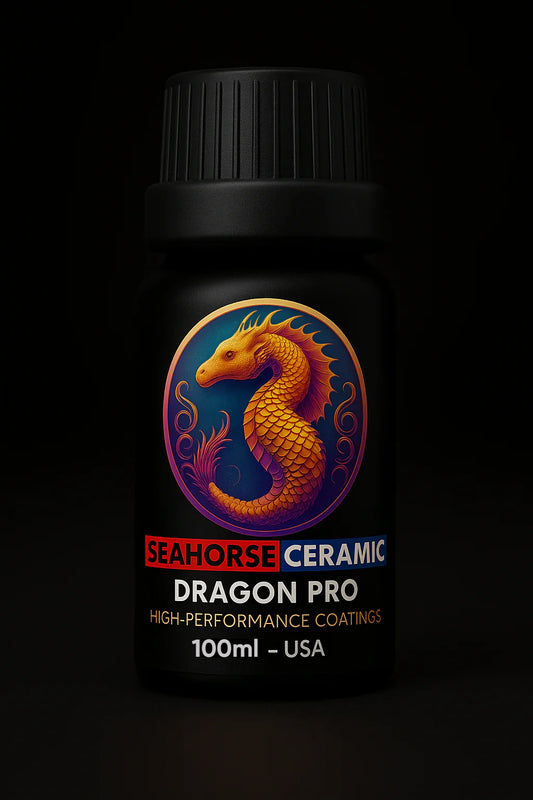
Seahorse Dragon Pro
For Marine Applications
Regular price From $195.00 USDRegular priceUnit price per$0.00 USDSale price From $195.00 USD -
Seahorse AutoCoat
Regular price From $65.00 USDRegular priceUnit price per$0.00 USDSale price From $65.00 USD



Chemistry & Application
A Chemist's Perspective on the Evolution of Surface Protection.
01. The Molecular Shift
Beyond SiO2: Polysilazane Technology
For years, the detailing industry has relied on SiO2 (Silicon Dioxide) as the standard for ceramic protection. While SiO2 revolutionized the market, chemistry has continued to evolve. At Seahorse Ceramic, we have moved beyond simple silica-based suspensions to advanced Polysilazane (PSZ) technology.
This results in a permanent conversion layer. The tighter molecular structure offers superior density and environmental resistance without the brittleness often associated with older ceramic technology.
02. Professional Engineering
High Solids & "Wet Edge" Technology
We understand that for many professionals, High Solids content is the benchmark for a premium coating. However, in traditional chemistry, high solids often mean an aggressive "flash" time. If the carrier solvents evaporate too quickly, leveling becomes a nightmare, leading to high spots and labor-intensive corrections.
At Seahorse Ceramic, we have engineered our formulas to deliver the High Solids performance you expect, but with our proprietary Wet Edge Technology. By precisely manipulating the evaporation rate of our carrier solvents, we have extended the working window significantly:
03. Structural Integrity
Bottom-Up Bonding & Layering
One of the unique characteristics of our chemistry is the Bottom-Up Bond. While the top layer remains "wet" to give you that longer working window, the chemical anchors are already reaching down into the substrate.
The Seahorse coating begins its cross-linking process at the surface interface first, ensuring that by the time you level the top layer, the foundation is already chemically locked to the paint or gelcoat. You aren't just applying a layer — you are anchoring a professional-grade shield from the bottom up.
Pro Tip: For maximum depth, Seahorse coatings can be recoated 15 minutes after leveling.
Post-Application Care Guide
Ensuring a 9H+ Cure: The First 7 Days
Phase 1: Initial 24 Hours
- •Keep it Dry: Avoid water for 4 hours.
- •Moisture: If it gets wet, dry with a soft microfiber towel.
- •No Covers: No canvas or boat covers for 24 hours.
- •Socks Only: If walking on decks is unavoidable — no shoes.
- •No Chemicals: Zero cleaners, waxes, or sprays.
Phase 2: Days 2–7
- •No Soap: Fresh water rinse only for the full first week.
- •Debris: Rinse bird droppings or salt immediately.
- •No Abrasives: Avoid brushes or magic erasers.
Phase 3: Long-Term
- •Hand Wash: Use pH-neutral or marine-safe soap.
- •No Auto Washes: Friction washes will degrade the finish.
- •Salt: Rinse with fresh water after every marine use.
Maintain the Perfection
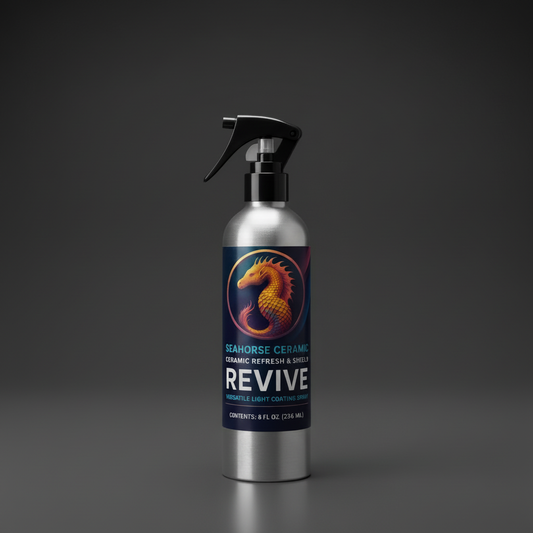
Reinforce your ceramic shield with Seahorse ReVive.
Apply monthly for maximum gloss — or at minimum every 6 months to maintain the ceramic matrix.
Chemistry aside — you get a predictable, rock-solid finish. It just works.