AutoCoat
High-gloss, extended working time, and flex-friendly durability for modern paint systems.
01. What It Is & Who It's For
Built for the Automotive Professional
AutoCoat is a professional-grade automotive ceramic coating designed for the detailer who needs repeatable results across a full day of installs. Modern paint systems — thin clear coats, flexible body panels, PPF-adjacent surfaces — demand a coating that bonds hard without going brittle. AutoCoat is built for exactly that.
If you are coating paint, clear coat, or automotive hard surfaces and you need a generous working window without sacrificing long-term durability, AutoCoat is the product in the Seahorse lineup engineered for your environment.
02. Core Chemistry
Polysilazane — Not SiO2
AutoCoat is built on an organopolysilazane backbone — a reactive polymer that undergoes chemical conversion with atmospheric moisture to form a dense, cross-linked ceramic matrix. This is structurally different from traditional SiO2-based coatings, which deposit glass particles onto the surface as the solvent evaporates.
SiO2 creates a protective barrier on top of the surface.
AutoCoat Polysilazane creates a permanent structural conversion — chemically anchored from the bottom up, while the surface remains workable above.
For automotive applications, this matters most on flexible body panels and modern thin clear coats. A coating that can't flex with the substrate will eventually crack. AutoCoat is engineered to move with the panel rather than against it.
03. Installer Advantages
Working Window & Bottom-Up Bonding
High-throughput automotive installs mean you are moving fast across multiple panels. The last thing you need is a coating that flashes before you've finished a door. AutoCoat is formulated with a working window that gives you time to coat and level consistently — without sacrificing the bond quality underneath.
Reference Working Time
In controlled conditions (~70–75°F, moderate humidity, low airflow), AutoCoat typically provides approximately 5 minutes of working time before leveling.
⚠ Surface temperature, shop airflow, direct sun, and relative humidity all significantly affect this window. Always perform a test panel in your specific conditions before committing to a full install.
While you work the surface, the cross-linking and bonding process begins immediately at the substrate interface — anchoring the coating from the bottom up while the top layer remains open and workable. By the time you level, the foundation is already chemically locked to the clear coat.
You are not racing the clock. You are finishing a surface that has already begun its permanent transformation.
04. UV Protection
Dual-Layer UV Inhibition
AutoCoat uses a two-component UV inhibition system that protects from both sides of the equation simultaneously — the surface underneath and the coating itself.
HALS Inhibitor
Hindered Amine Light Stabilizers work beneath the coating to protect the substrate itself — the paint and clear coat underneath — from UV degradation over time.
UV Absorber
A dedicated UV absorber works within the coating matrix itself — protecting the coating from breaking down under prolonged sun exposure, preserving gloss and structural integrity.
One protects what is underneath. The other protects the coating itself. Together, they form a dual-layer UV defense system built for long-term appearance stability.
05. Optical Performance
Sunlight-Activated Gloss Enhancers
AutoCoat contains optical gloss enhancers that are genuinely worth seeing before you apply them. Hold the bottle in direct sunlight — the chemistry inside responds visibly to UV light in a way that is difficult to describe and easy to appreciate.
On the surface, these enhancers contribute to the deep, wet-look gloss that AutoCoat delivers on paint and clear coat. It is not a marketing claim. It is chemistry you can see working.
06. Technical Snapshot
At a Glance
| Chemistry | Organopolysilazane ceramic (not SiO2-only) |
| Working Time | Condition-dependent. ~5 min reference at 70–75°F. Always test your environment first. |
| UV Protection | Dual-layer: HALS (substrate) + UV Absorber (coating matrix) |
| Coverage | Varies with surface condition, porosity, and technique. One bottle covers significant area — test your application rate. |
| Shelf Life | 18 months unopened. 30 days once opened. Keep sealed and cool. |
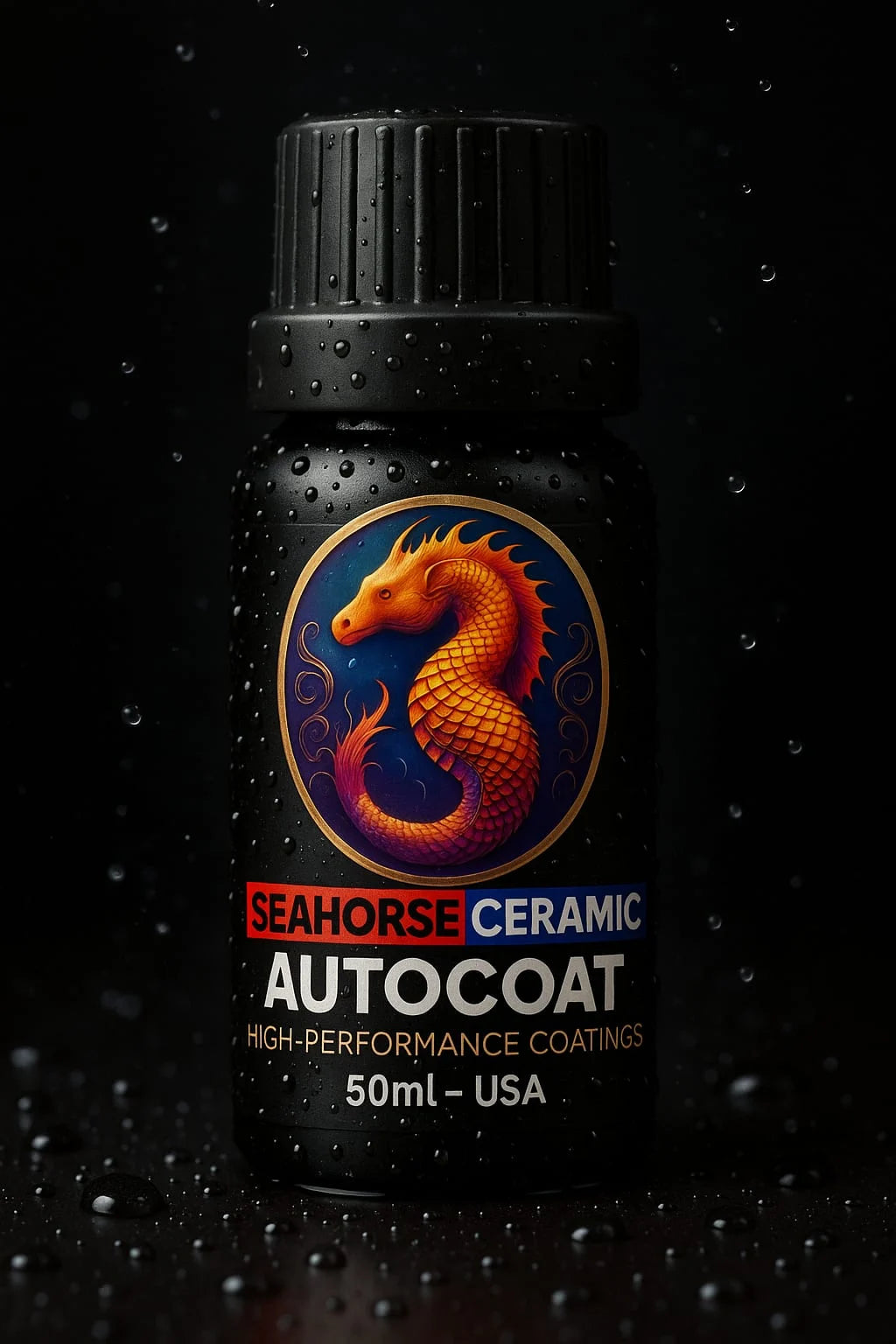
| Package Size | 50mL |
| Surfaces | Automotive paint, clear coat, hard exterior surfaces |
07. Application
Step-by-Step Summary
08. Cure Guidance
The First 30 Days
09. Maintenance
Keep It at Its Best
Use a pH-neutral automotive soap. Avoid high-alkaline degreasers and friction-based washes. Rinse thoroughly after exposure to road salt or industrial fallout.
Reinforce your AutoCoat with Seahorse ReVive — applied monthly for maximum performance, or at minimum every 6 months to maintain the ceramic shield.
Shop ReViveAlso in the Lineup